📏 Approved list criteria
The criteria for joining The Vault's approved list, and the requirements for staying on it.
The Vault delegates to validators on its approved list. This page covers the criteria the Validator Board reviews before it approves a validator, and the requirements a validator must keep meeting to stay on the approved list.

How approval works
The Validator Board is made up of validators from inside The Vault's stake pool who currently serve as board members. The board reviews each application and votes on the validator's ecosystem contributions.
When a validator passes the board's review, the validator is approved and joins the approved list. There is no waitlist. Approved validators can begin participating in The Vault's delegation programs: the Direct Stake Leaders bucket and the Elite Performance bucket (Figure 16.3). To apply, see Validator application process.
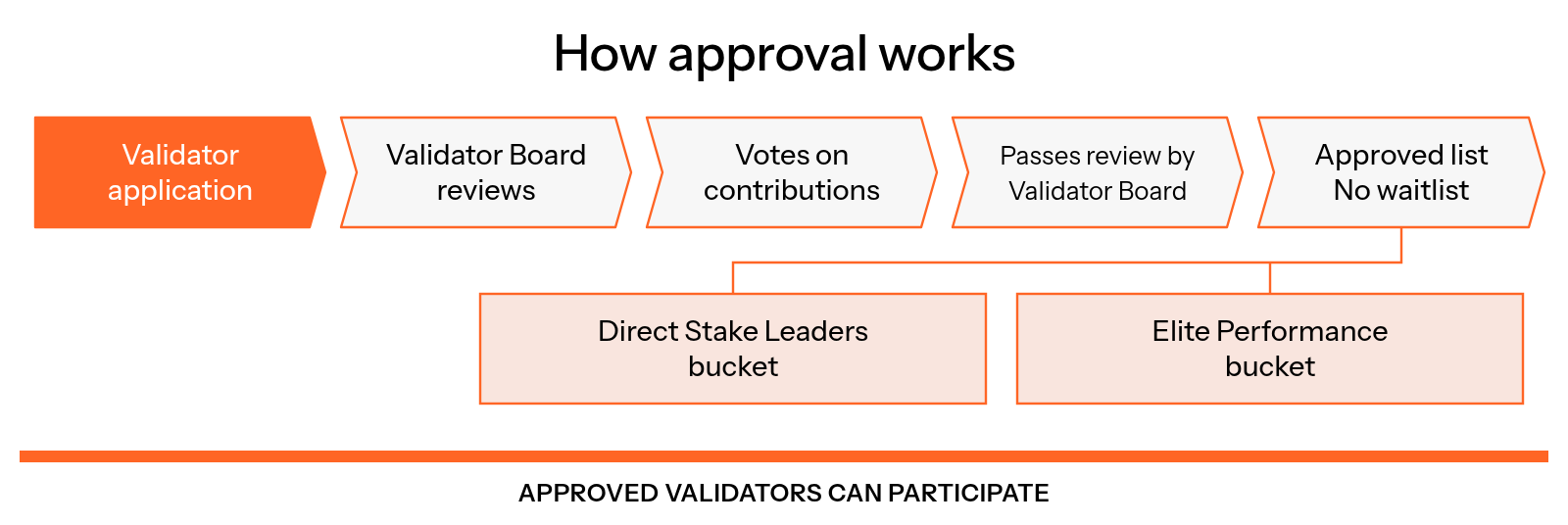
Figure 16.3: How approval works
Validator performance evaluation
Validator performance is evaluated on uptime and downtime (Figure 16.4).
Measuring uptime and downtime
Validator uptime and downtime are measured using existing tools:
- Stakewiz provides uptime tracking.
- The Dune Validator Dashboard shows uptime for the last 30 days using Stakewiz data.
Uptime evaluation factors
The Stakewiz API calculates validator delinquency based on the number of minutes a validator has been delinquent.
Minimum epochs required for evaluation
The number of epochs needed for an evaluation is:
- Preferred: 20 epochs
- Minimum: 10 epochs
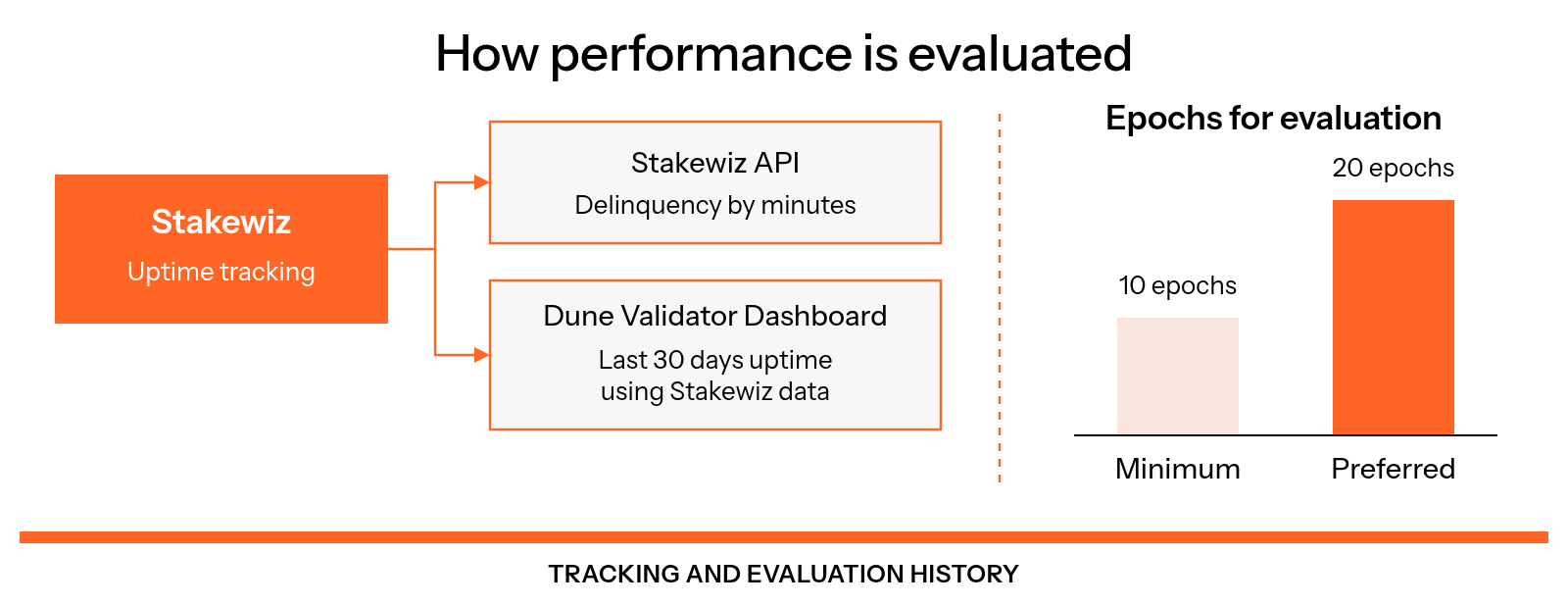
Figure 16.4: How performance is evaluated
Approval standards
The standards for approval are:
- Validators must meet uptime requirements.
- Validators must adhere to commission limits.
The Validator Board weighs these factors when it approves or removes a validator (Figure 16.5):
- Ecosystem contribution
- APY (vote credits)
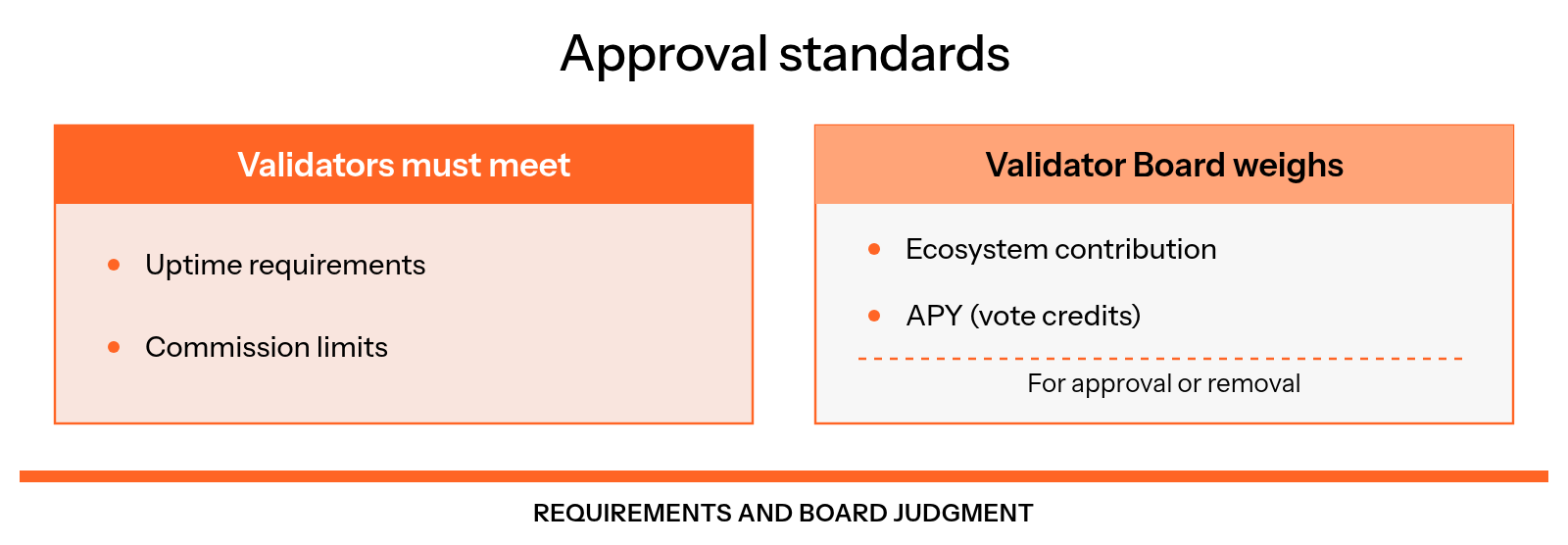
Figure 16.5: Approval standards
Delinquency management
Delinquency is graded by level and tracked with Stakewiz.
Defining delinquency levels
The delinquency levels are (Figure 16.6):
- Excessive delinquency: More than 8 hours of delinquency over the past 30 days.
- Problematic delinquency: More than 4 hours of delinquency over the past 30 days.
- Concerning delinquency: More than 1 hour of delinquency over the past 30 days.
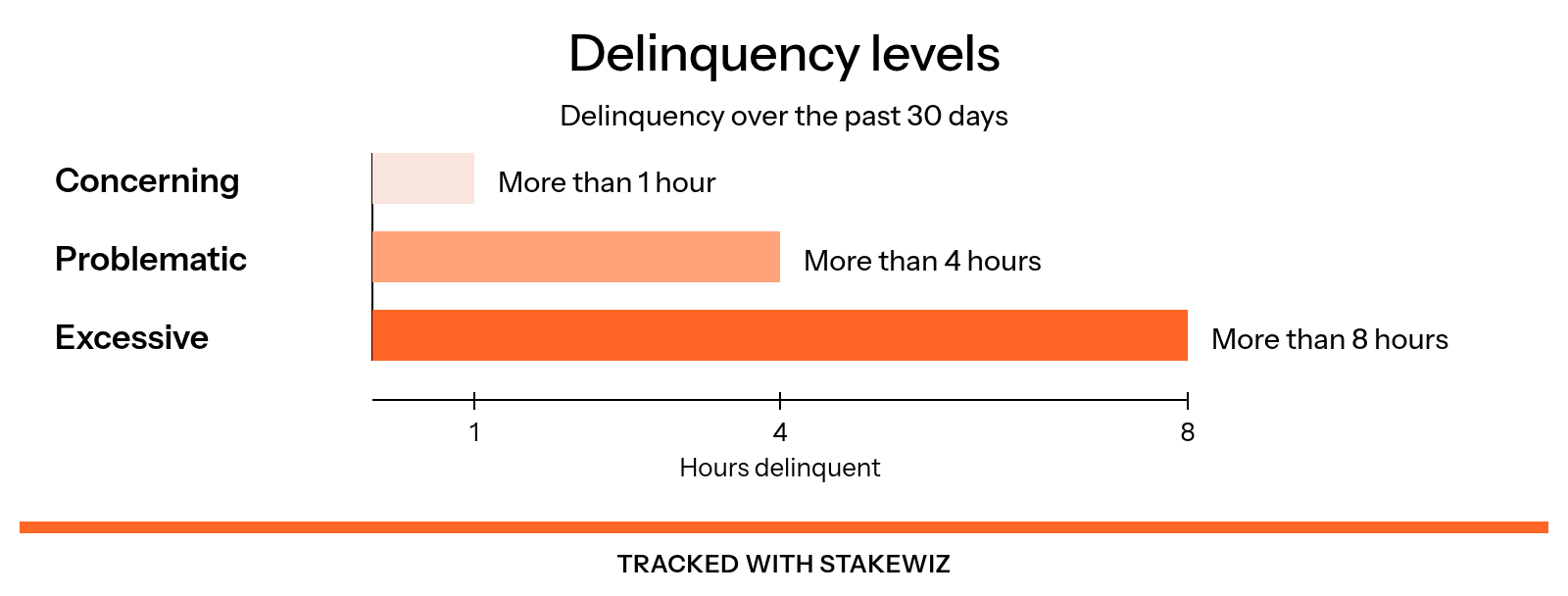
Figure 16.6: Delinquency levels
Tracking delinquency
The Stakewiz uptime score (via their API) is used for tracking.
Vote credit requirements
Vote credits are handled as follows:
- Minimum vote credit requirements: No strict minimum, as vote credits are already captured in the uptime metric.
- Impact of vote credits: Vote credits impact APY, which the Validator Board considers when it approves a validator.
Client compliance standards
To meet the required client compliance, validators must run one of the following:
- Jito-enabled client
- Paladin-enabled client
Stake amount requirements
The maximum stake threshold is 500K SOL (not applicable to direct stake).
Commission limits
The commission limits are 5% commission and 10% MEV (exceptions can be made by The Vault contributors). Raising your commission above 5% or your MEV commission above 10% (the Solana Foundation Delegation Program criteria), even for one epoch, can block your stake for 10 epochs.
Validator contributions to the Solana ecosystem
The Validator Board assesses each validator's contributions to the Solana ecosystem (Figure 16.7).
Metrics for evaluating contributions
Validator contributions to the Solana ecosystem are difficult to quantify but can generally be assessed based on, but not limited to:
- Development of apps in the Solana ecosystem
- Solana community participation (e.g., notable individuals, investors with strong communications impact, etc.)
- Development of infrastructure-related tools for the ecosystem (e.g., dashboards and validator utilities)
- Open source development within the Solana ecosystem
- Membership in Solana projects with meaningful contributions
Quantifying contributions
Contributions are assessed as follows:
- Validators must clearly describe how their contributions help the ecosystem when they apply.
- Evaluations are subjective and rely on board members making qualitative judgments.
- A voting system among board members is used to assess ecosystem contributions.
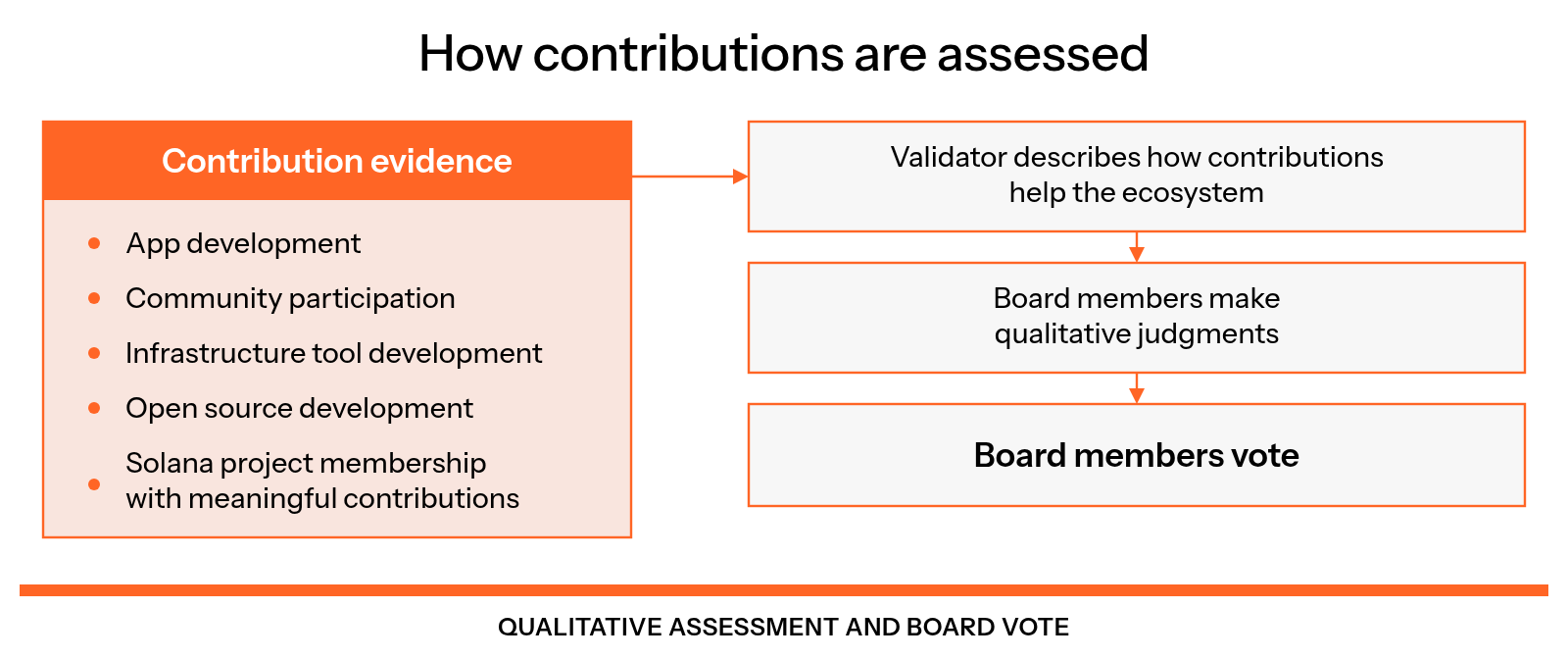
Figure 16.7: How contributions are assessed
Staying on the approved list
Approved validators are expected to maintain compliance with The Vault's governance and participation requirements:
- Participation in governance: Validators must vote on all SIMD proposals on the Solana chain; failure to do so may result in removal from the approved list.
- Uptime and performance: Validators must continue meeting the performance, delinquency, client and commission criteria on this page.
- Community contributions: Validators lacking ecosystem contributions may be removed from the approved list until their contributions are deemed sufficient for reapproval.
- Fees: Validators are expected to settle Stake-as-a-Service (SaaS) fees in a timely manner.
The Vault reserves the right to pause new approvals at any time.
Non-compliance and corrective actions
The corrective actions for non-compliance are:
- Failure to vote on proposals: Risk of removal from the approved list.
- Performance issues: Validators not meeting base uptime criteria or becoming delinquent may be removed from the approved list.
- Lack of contributions: Validators who fail to make meaningful contributions to the ecosystem may be removed from the approved list.
Misconduct and exploits
Any validator caught attempting to bribe, use misleading statements in their application, or exploit loopholes to gain approval may be banned from the stake pool entirely. This includes:
- Fraudulent applications, bribery, or deceptive practices.
- Participating in malicious activities that harm the network or the users of the network, for example, but not limited to, sandwich attacks.