🌊 Liquid staking
Maximize your SOL's potential with flexible liquid staking options.
The Solana network relies on validators to maintain its security, operating on a proof-of-stake consensus mechanism. To contribute to the network, SOL must be staked with a validator. However, traditional staking comes with certain limitations.
Challenges of traditional staking
- Locked funds: Staked SOL is locked for at least 1 epoch (currently about 32 hours), preventing its use for providing liquidity, generating yield, or other activities.
- Limited decentralization: Staking with just one validator concentrates stake, which is not ideal for network decentralization.
The solution: liquid staking
Liquid staking allows you to stake SOL through a stake pool, like The Vault, and receive a liquid staked token (vSOL) in return. This token represents your staked SOL and unlocks additional opportunities:
- Provide liquidity: Use vSOL in liquidity pools to earn additional yield.
- Generate yield: Participate in DeFi protocols while earning staking rewards.
- Collateral for borrowing: Use vSOL as collateral to borrow funds.
Supporting decentralization
By staking through The Vault without choosing a validator, your SOL becomes undirected stake and is distributed across multiple validators, aligning with the pool’s community goals. This ensures:
- Greater network decentralization: Stake is spread among smaller or community-centric validators.
- Optimized rewards: Your stake continues to grow while maintaining flexibility.
Liquid staking combines the best of both worlds, helping secure Solana while enabling you to maximize the utility of your staked SOL (Figure 3.11).
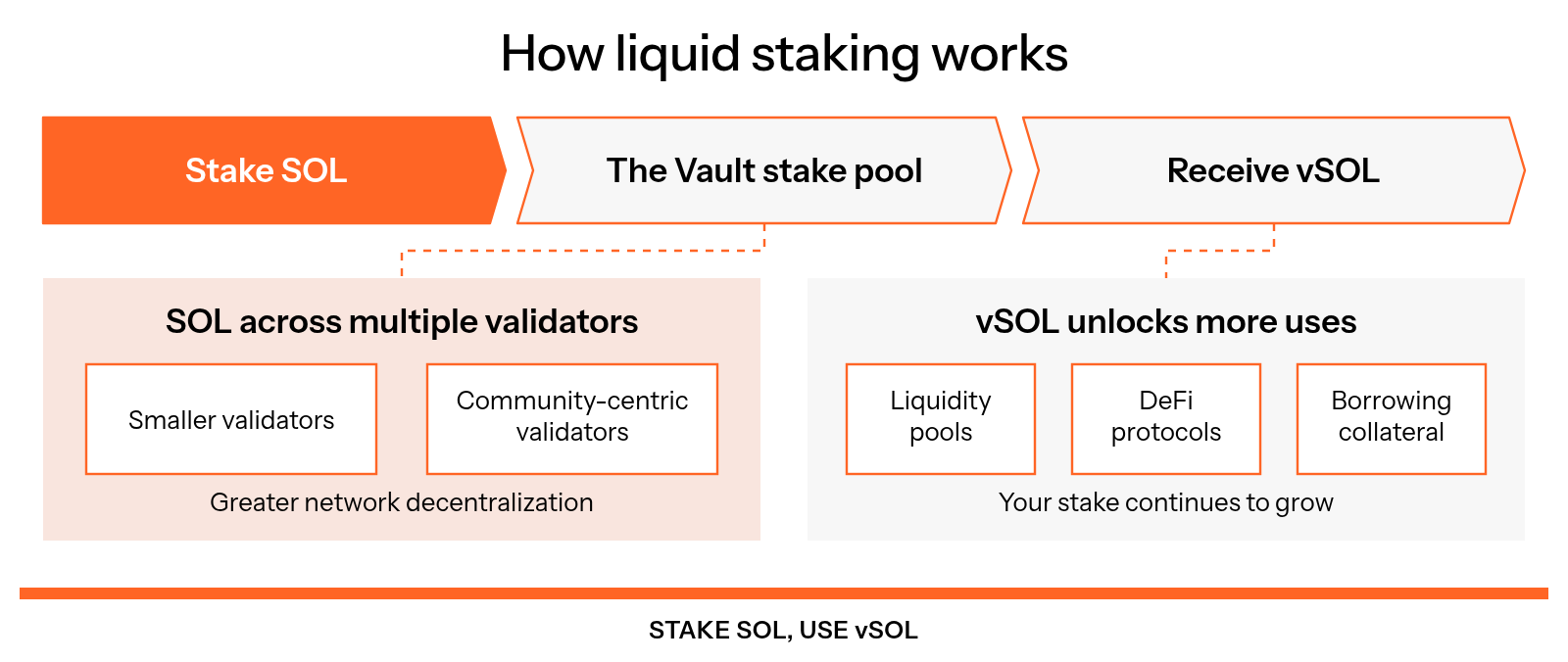
Figure 3.11: How liquid staking works