❓ Gauge FAQs
Learn how it all works.
This page answers common questions about gauges, vote buying on Votex, epoch timing, stake distribution and validator requirements.

Gauges
How do gauges work?
Gauges allow validators to receive stake through a voting mechanism. When participating in gauges, there is an inherent delay before full impact is realized. For best results, validators should engage for three consecutive weeks to receive the full stake allocation implied by their voting power.
Votes must be renewed every week in order to continue directing stake to a validator.
How long do gauge epochs last?
Gauge epochs, also known as voting epochs, last seven days. These epochs are independent from Solana network epochs and exclusively govern gauge voting behavior.
What is the recommended budget approach?
A practical approach is to begin with a smaller budget to understand system dynamics. Validators should plan for at least two to three consecutive weeks of voting and evaluate returns over that full period rather than a single week. Expected earnings should be estimated based on gauge stake, commission rate, and validator APY, then compared against vote buying costs.
How much voting power does my spend buy?
Voting power is determined relative to total epoch spending. If total spend for an epoch is $1,200 and a validator spends $1,000, that validator controls approximately 83% of the voting power for that epoch.
When should I expect returns?
When using Votex, it generally takes a full week before gauge impact becomes visible. This is why consecutive participation is important. Impact is limited in the first week, realized fully in the second week, and optimized by the third week (Figure 9.15). Ending participation after only one week typically results in suboptimal outcomes.
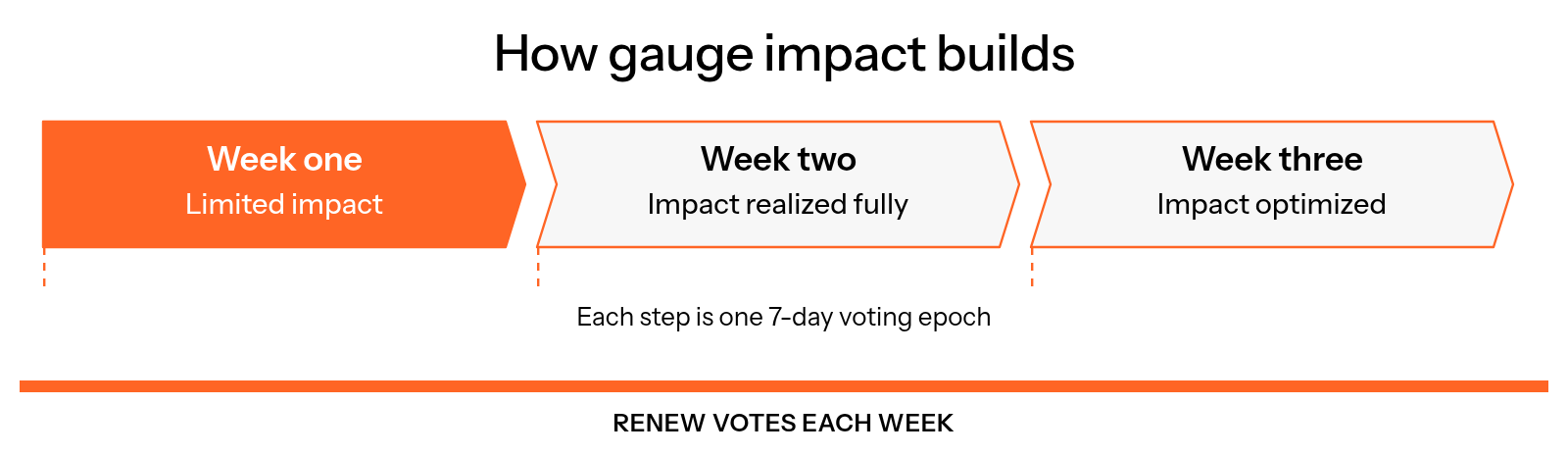
Figure 9.15: How gauge impact builds
Votex and vote buying
Can I use multiple wallets?
Yes. Wallet choice is irrelevant. Votes may be purchased using any wallet and different wallets may be used each week. The only requirement is that votes are purchased for the correct validator address.
What is the voting window?
Vote buying is open for six days per voting epoch. The final day of each epoch is closed to allow votes to be finalized before the next epoch begins. Current status can be checked at https://votex.so/daos.
Why does my estimated stake on Votex change after I buy votes?
Your share depends on how much everyone spends and how much veV is delegated to the market, so the estimate moves while vote buying is open. The numbers are final only when the buying window closes before the next gauge epoch.
When can I buy votes for the next epoch?
Votes may be purchased at any point during the six day open window. The window opens at the start of a new voting epoch and closes on the final day before the next epoch (Figure 9.16).
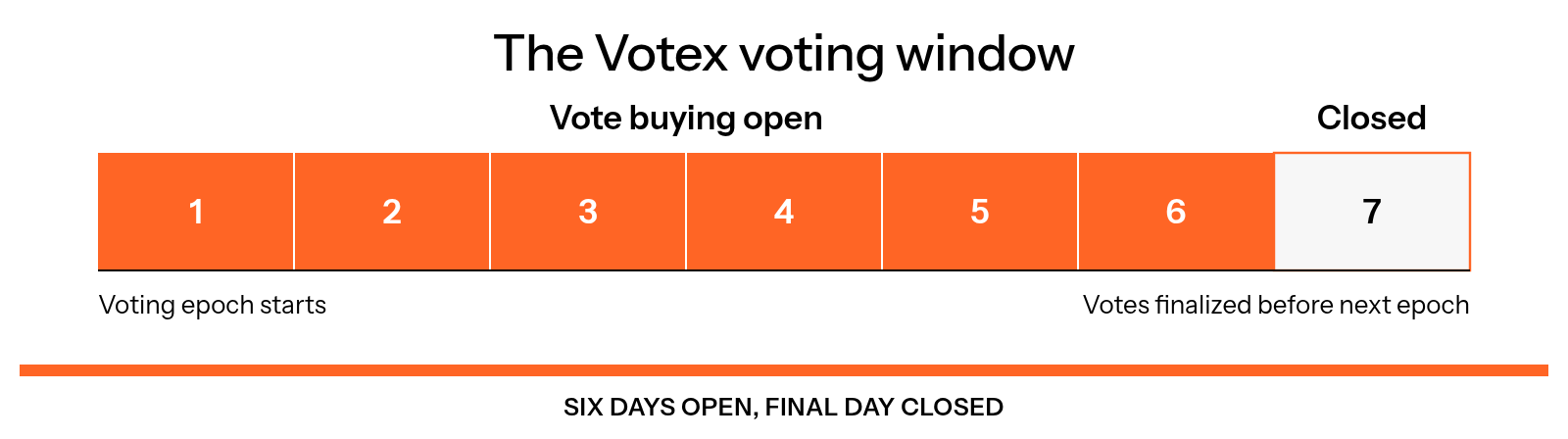
Figure 9.16: The Votex voting window
How do I know when the next voting epoch starts?
The Gauge cycle timeline on The Vault's Gauges page shows the current epoch and the time remaining until the next one begins.
Epochs and timing
What is the difference between Solana epochs and voting epochs?
Solana epochs are blockchain level epochs that currently last about 32 hours. Voting epochs, also called gauge epochs, are specific to The Vault, last seven days and govern gauge voting. The two don't line up: votes count only once a new voting epoch starts, and after that the stakebot moves stake to the new targets over the following Solana epochs.
When do votes take effect?
Votes purchased during a voting epoch apply to the following epoch, so you wait until that epoch starts. Votes are cast before the next epoch begins, deltas appear shortly after epoch start, and the stakebot then moves the stake over the Solana epochs that follow (Figure 9.17).
How long do votes remain active?
Voting power remains active for one voting epoch only. To maintain gauge stake, renew Votex purchases and veV votes each week. Wallets with 50,000 veV or more have their votes carried over each epoch.
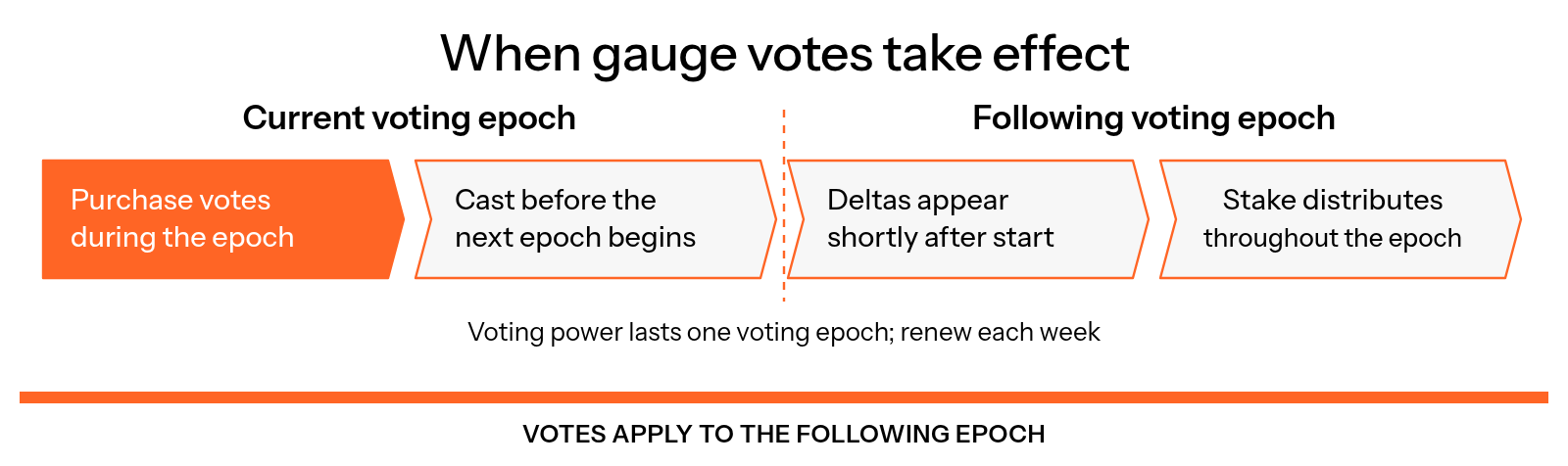
Figure 9.17: When gauge votes take effect
Stakebot and stake distribution
How often does the stakebot run?
The stakebot runs every three hours and reallocates stake based on current deltas and priority rules.
How long until stake appears?
Delta changes typically appear within three hours of a new voting epoch starting. The stakebot then moves stake over the following Solana epochs, usually 1 to 2, and longer depending on queue size, priority tier, and whether the validator is receiving a large amount of stake for the first time.
The stakebot distributes gradually to avoid harming APY.
What is stake priority?
Stake is processed in priority order. Direct stake and gauge stake are treated as high priority and processed ahead of undirected stake. Within each category, larger deltas receive priority.
Will stake be lost if distribution crosses epochs?
No. Gauge stake remains prioritized even if distribution spans across epochs. Validators that continue voting experience faster stabilization since less redistribution is required.
What does it mean if I see a delta but no stake?
A visible delta confirms that votes were cast successfully and stake is queued for distribution. The stakebot will process the allocation according to priority rules (Figure 9.18). First time large movements may experience minor delays.
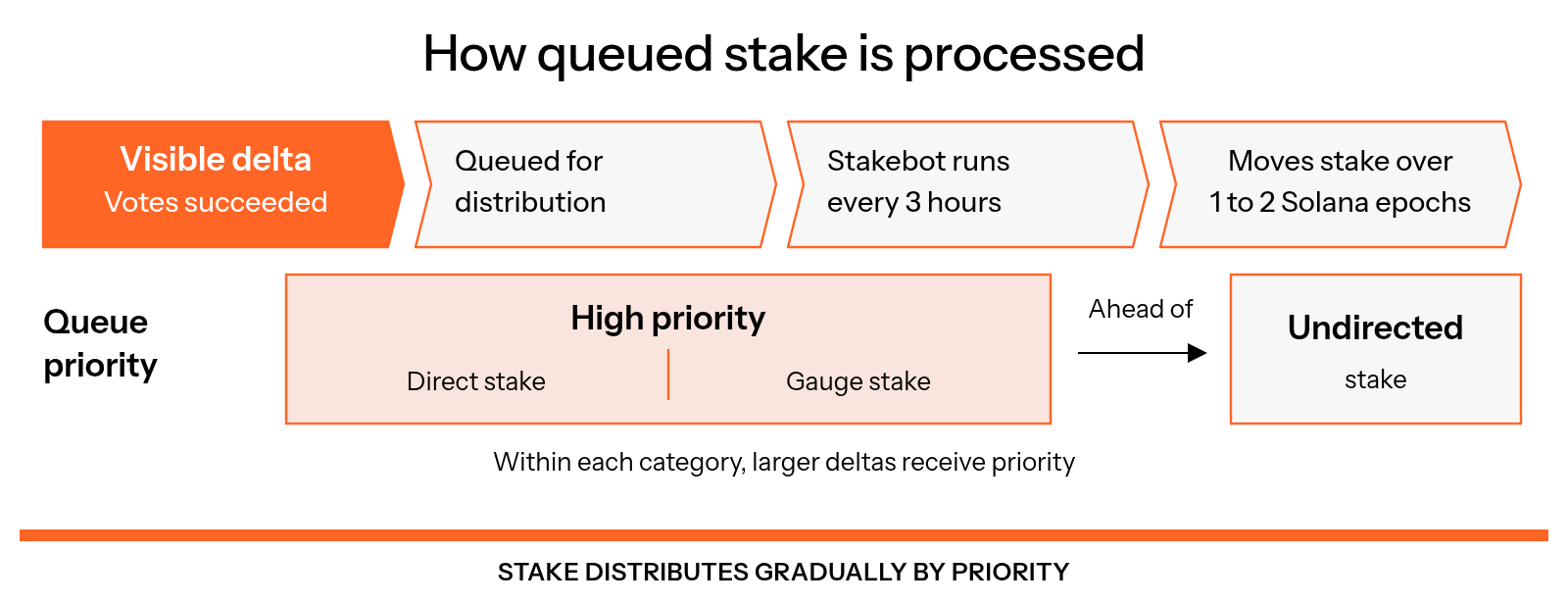
Figure 9.18: How queued stake is processed
Validator requirements
Is the stake pool permissionless?
Partly. Any validator that meets the gauge eligibility criteria can receive gauge stake, through its own veV or votes bought on Votex, and can receive direct stake without approval. Approval by the Validator Board adds the Direct Stake Leaders and Elite Performance buckets.
How do I add my validator to the gauges?
Open your validator's page on the validator dashboard, connect your wallet and create its gauge with the button in the Info section. The validator must meet the eligibility criteria. A daily sync adds new gauges to the gauge list, so it can take up to 24 hours to appear.
Do I pay Stake-as-a-Service fees on gauge stake?
No. Gauge stake is not charged. Stake-as-a-Service fees apply only to stake from the Direct Stake Leaders and Elite Performance buckets.
Can smaller validators receive gauge stake?
Yes. Any validator meeting the minimum requirements may receive gauge stake regardless of size.
Resources and tools
Where can validator deltas be viewed?
Validator deltas are displayed at https://thevault.finance/validators in the far right column.
Where can stakebot data be reviewed?
Stakebot data is published at https://github.com/SolanaVault/stakebot-data.
Analytics are also available via Kagren’s dashboard at https://dune.com/kagren0/the-vault-validators.
Where can voting epoch status be checked?
Epoch timing and gauge information are available on The Vault's Gauges page.
Vote buying availability is shown at https://votex.so/daos.
What is the veV threshold for automatic voting?
Wallets holding approximately 50,000 veV automatically vote each week. Wallets do not need to be linked and multiple wallets may be used.
Will there be more documentation?
Additional documentation is in progress, including deeper explanations of gauge mechanics, performance metrics, and improved dashboards.
Still have questions
If your question is not covered here, reach out to support in The Vault Discord or consult the official documentation for the most up to date information.